
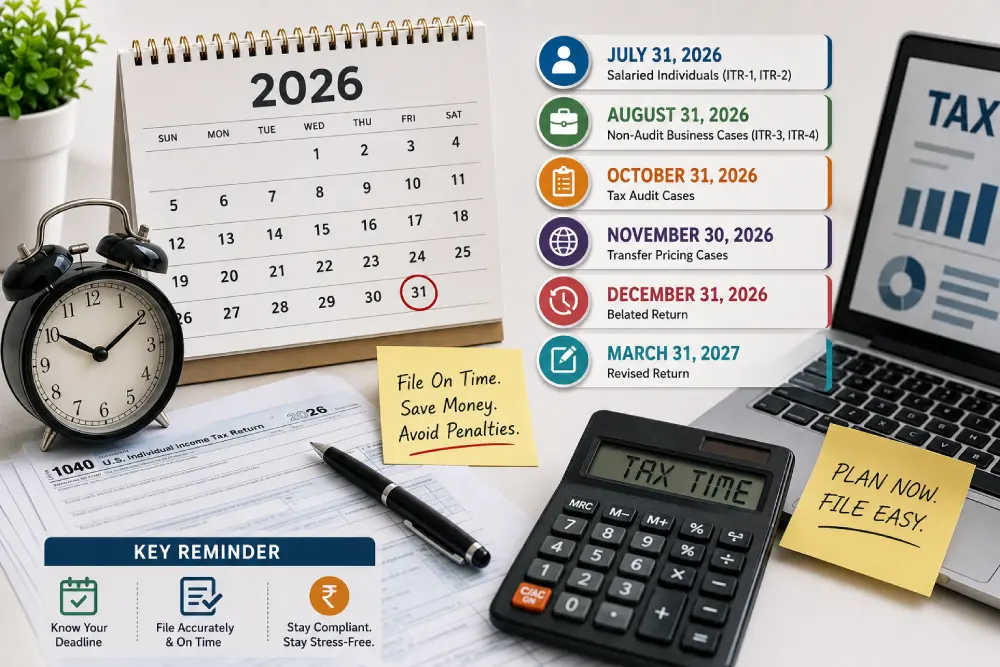
Tax due deadlines are stressful. You know you have to file. But when is the last day to do taxes?
It changes based on who you are and how you earn. Missing the tax due deadline brings penalties. Interest. Headaches.
So let us break down the tax due deadline with a simple and clear guide.
What Is the Tax Due Deadline for Most People?
The big question. When is the deadline to file taxes? For most salaried individuals, the tax return deadline is July 31, 2026. This applies to people filing ITR-1 and ITR-2. Salaried employees. Pensioners. Those with capital gains.
If that sounds like you, mark July 31 on your calendar. That is the last day to file your taxes without penalty.
Different Deadlines for Different People
The taxation deadline is not the same for everyone.
August 31, 2026 – For Business Owners Without Audit
Freelancers. Consultants. Small business owners. If you have business income but no audit requirement, you get extra time. When is the last day to file your taxes in this case? August 31, 2026. This applies to ITR-3 and ITR-4 filers. Non-audit cases.
October 31, 2026 – For Tax Audit Cases
Businesses with turnover above certain limits must get audited. These taxpayers file by October 31, 2026. The tax audit report is due by September 30.
November 30, 2026 – For Transfer Pricing Cases
International transactions? Specified domestic transactions? The due date is November 30, 2026.
What If You Miss the Tax Return Deadline?
Missing the tax due deadline is not ideal. Penalties apply. Interest accrues. You may lose the ability to carry forward losses. But there is still a chance to fix things.
Belated Return – December 31, 2026
If you miss the original deadline, file a belated return. When does tax season end for belated filings? December 31, 2026. Late fees apply. But it is better than not filing at all.
Revised Return – March 31, 2027
Made a mistake? Forgot to claim a deduction? You can file a revised return. The deadline is March 31, 2027. This gives you extra time to correct errors.

What About Filing an Extension?
If you need more time, you can file an extension. File tax extension requests are common. In the US system, an extension gives you until October 15, 2026 to file. But here is the catch. The extension is for filing, not paying.
You still need to pay taxes owed by the original deadline. Extend tax deadline? Yes. Extend payment? No. Interest and penalties still apply if you pay late.
Important Advance Tax Dates
For business owners and freelancers, advance tax applies. Pay in installments. Key advance tax due dates:
– June 15
– September 15
– December 15
– March 15
Missing these can lead to interest penalties.
Key Tax Return Dates at a Glance
| Taxpayer Category | Tax Due Deadline |
| Salaried Individuals (ITR-1, ITR-2) | July 31, 2026 |
| Non-Audit Business Cases (ITR-3, ITR-4) | August 31, 2026 |
| Tax Audit Cases | October 31, 2026 |
| Transfer Pricing Cases | November 30, 2026 |
| Belated Return | December 31, 2026 |
| Revised Return | March 31, 2027 |
Conclusion:
Knowing the tax due deadline saves you money. Stress less. Avoid penalties. Figure out which category you fall into. Mark your deadline. If you cannot make it, consider extending the tax deadline.
But remember, extension is for filing, not paying. File on time. Pay what you owe. Your future self will thank you.
Frequently Asked Questions
When is the tax due deadline for 2026?
For most salaried individuals, the tax due deadline is July 31, 2026. Business owners without an audit have until August 31. Tax audit cases filed by October 31.
When is the last day to file taxes without penalty?
The last day to file taxes without penalty depends on your category. For salaried employees, it is July 31, 2026. For business non-audit cases, it is August 31, 2026.
What happens if I miss the tax return deadline?
You may face late fees, interest, and lose the ability to carry forward losses. You can still file a belated return by December 31, 2026, but penalties apply.
Can I extend the tax deadline?
Yes. You can file an extension. In the US, filing an extension gives you until October 15, 2026. But you must still pay taxes owed by the original deadline.
When does tax season end for most people?
For most individual taxpayers, tax season ends on July 31, 2026. Business owners and audit cases have later deadlines extending to October or November.
When is the last day to file your taxes for business owners?
For business owners without audit, the last day is August 31, 2026. For those requiring a tax audit, the deadline is October 31, 2026 .
What is the erc credit deadline?
The ERC deadline for Q3 and Q4 2021 claims was January 31, 2024. Claims filed after that date generally cannot be allowed. For claim disputes, a streamlined extension process is available for eligible taxpayers.
What are the advance tax due dates?
Advance tax instalments are due on June 15, September 15, December 15, and March 15. Missing these can result in interest penalties under tax laws.
How do I file a tax extension?
You can file a tax extension online, by mail, or through an electronic payment. Form 4868 is used for US federal tax extensions. File by April 15 for an October 15 extended deadline.
What is the last day tax can be filed for audit cases?
For tax audit cases, the last day is October 31, 2026. The tax audit report must be furnished by September 30, 2026.
