Taxes hit everyone. Paychecks get smaller. Refunds show up. Rules keep changing. Getting a handle on income tax is not just for number crunchers. It is for anyone bringing home a paycheck.
What Is Tax and Why Do We Pay It
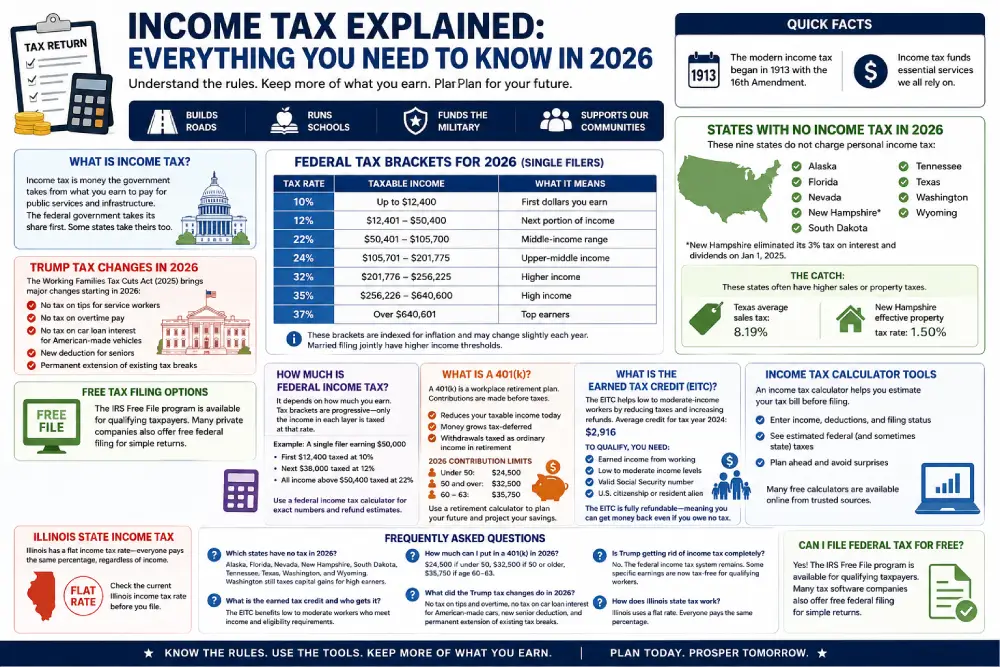
Everyone asks what is income tax at some point. Here is the straight answer. Income is what the government takes from what you earn. That money builds roads, runs schools, funds the military, and keeps things going.
The feds take their cut first. Some states take theirs too. How much comes out depends on what you make. More money usually means more taxes.
When did income tax start in America? The modern version kicked off in 1913 with the 16th Amendment. That gave Congress the green light to tax earnings directly. Before that, the government relied on tariffs and other fees.
Federal Tax Brackets for 2026
Federal income tax brackets decide how much gets pulled from your check. The system works in slices. Different chunks of your money get taxed at different rates. Here is what single filers face in 2026:
– 10% on income up to $12,400
– 12% on income from $12,401 to $50,400
– 22% on income from $50,401 to $105,700
– 24% on income from $105,701 to $201,775
– 32% on income from $201,776 to $256,225
– 35% on income from $256,226 to $640,600
– 37% on income above $640,601
These federal tax brackets move a little each year with inflation. Married couples filing together have their own higher thresholds.

Trump Tax Changes in 2026
The Trump income tax policies shook things up. The Working Families Tax Cuts Act passed in 2025 and hit the 2026 filing season. Here is what shifted:
– No tax on tips for service workers
– No tax on overtime pay
– No tax on car loan interest for American-made vehicles
– New deduction for seniors
– Permanent extension of existing tax breaks
Folks keep asking is Trump getting rid of tax. The short answer is no. The income tax system is still here. But certain workers get a break on specific earnings.
Free Tax Filing Options
Free income tax filing saves people cash on preparation costs. The IRS runs Free File for lower income folks. Some private companies offer free versions too. These handle basic federal returns just fine.
How Much Is Federal Income Tax
The question how much is federal tax depends entirely on what you make. The percentage shifts based on your income level.
A single person earning $50,000 hits the 22% bracket. But only the money above $50,400 gets taxed at that rate. The rest gets hit with lower rates.
Running a federal income tax calculator shows the exact number. These tools reveal what comes out and what might come back as a refund.
States With No Tax
Some places skip state-level tax. These nine states charge zero personal income in 2026:
- Alaska
- Florida
- Nevada
- New Hampshire
- South Dakota
- Tennessee
- Texas
- Washington
- Wyoming
New Hampshire just jumped on the list. It scrapped its final 3% tax on interest and dividends on January 1, 2025.
Here is the catch. These states usually hit you harder on sales or property taxes. Texas charges an 8.19% average sales tax. New Hampshire has a 1.50% effective property tax rate.
What Is a 401k and How Does It Affect Taxes
What is a 401k pops up in retirement talks all the time. A 401k is a workplace retirement account. Money goes in before taxes get taken out. Here is how it rolls. Contributions shrink your taxable income for the year. The money grows untouched until you pull it out. At retirement, those withdrawals get taxed as regular.
In 2026, the contribution limit hits $24,500 for people under 50. Those 50 and older can put in $32,500. People between 60 and 63 can stash away $35,750. A best retirement calculator helps you see where you stand. It projects future balances and retirement income.
What Is the Earned Tax Credit
It matters for low to moderate earners. The EITC cuts your tax bill and can boost your refund. About one in five eligible people miss out on this credit. The average amount for tax year 2024 was $2,916.
To qualify you need:
- Earned income from working
- Low to moderate income levels
- Valid Social Security number
- U.S. citizenship or resident alien status
The EITC is fully refundable. Even folks who owe zero taxes can get the money back.
Income Tax Calculator Tools
An income calculator helps you estimate your tax bill before filing season hits. These tools ask for income, deductions, and filing status. A federal income tax calculator shows your estimated federal taxes. Some tools include state taxes too. Results help you plan and dodge surprises.
Conclusion
It touches nearly every working person in America. The rules change all the time. 2026 brought big updates under the Working Families Tax Cuts Act.
Knowing the basics keeps you from getting blindsided. Check the federal income tax brackets to understand your withholding. Use an income tax calculator to estimate what you owe. Claim credits like the EITC if you qualify.
State taxes are all over the map. Nine states have no tax at all. Others like Illinois charge a flat rate. Learn the rules for where you live.
Plan for retirement with a 401k. Contributions lower your taxable income today. Use a best retirement calculator to see where you stand for the future.
Frequently Asked Questions
Which states have no tax in 2026?
Alaska, Florida, Nevada, New Hampshire, South Dakota, Tennessee, Texas, Washington, and Wyoming. Washington still taxes capital gains for high earners though.
What is the earned tax credit and who gets it?
The EITC cuts taxes and boosts refunds for low to moderate workers. You need earned income, a valid SSN, U.S. citizenship or resident status, and income below certain caps.
How much can I put in a 401k in 2026?
The limit is $24,500 if you are under 50. Hit 50 or over and you can do $32,500. Between 60 and 63? You get $35,750.
What did the Trump tax changes do in 2026?
They scrapped taxes on tips and overtime, killed tax on car loan interest for American cars, added a senior deduction, and made existing tax breaks permanent.
Is Trump getting rid of income tax completely?
Nope. The federal tax system stays. Some specific earnings like tips and overtime are now tax-free for qualifying workers.
How does Illinois state tax work?
Illinois uses a flat rate. Everyone pays the same percentage. No progressive brackets like the feds use.
What should I look for in a retirement calculator?
Find one that factors in your age, income, contribution rate, employer match, and projected returns. Plenty of good free ones exist online.
Can I file federal tax for free?
Yes. The IRS has Free File for qualifying folks. Some private tax prep companies also offer free federal filing.
